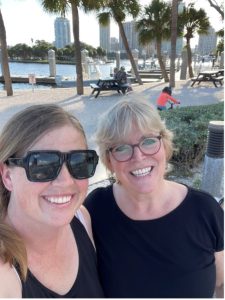
On September 8, 2024, LIFEazine founder Gonny Gutierrez (a Baby Boomer) and her friend Emily Fuentes (a Millennial) met up in St. Petersburg, FL, to discuss the importance of journaling, resulting in creating a personalized life story summary.
Gonny: I’ve always thought of writing a life story summary as something you do when you’re older, reflecting back on everything life has brought you. But you’re thinking about starting one now, in your late 30s?
Emily: Yeah, I am! Recently, I’ve been thinking how valuable it could be to document my life as it’s happening, year by year and decade by decade, capturing my growth along the way. It helps me reflect on where I’ve been and where I’m going. Each decade feels so different already. In my 20s, I was figuring out my career and relationships. Now in my 30s, I’ve got a better sense of who I am, but my challenges and goals have shifted. Writing about those changes helps me understand myself better. It’s like having a long-term record of my personal growth.
Gonny: Interesting! When you break it down by decade like that, it gives you more structure. And I guess reflecting on your progress could help you make sense of things sooner rather than later.
Emily: Yup! Plus, it’s not just about me. I think a lot about legacy and what I want to pass down to my girls, even though I’m not at that “legacy stage” yet. Life story writing is not just for older people, you know! Capturing my life right now — my thoughts, struggles, and decisions — could be really meaningful for my kids or grandkids one day. It’s not just the big milestones. For me, writing and evaluating my life by decade helps me document even the smaller but significant moments — like a career shift, a friendship that really impacted me, or a tough decision I made. Those are the things I might forget if I wait until I’m much older to start.
Gonny: Totally understand! Sometimes I have trouble remembering all the details of certain parts of my life. If I had started writing earlier, I’d probably have a much clearer picture of everything. So, you’re not waiting for the “big life event” to write about — you’re building the story as it unfolds.
Emily: That’s right! And to be honest, writing about it also helps my mental and emotional well-being. It’s like therapy in a way, helping me process what I’ve been through and be grateful for where I am now. I think that’s something both our generations can relate to. And I love the idea that my life story is ongoing. It’s not just a static summary at the end of my life but a living narrative that evolves as I do. Plus, I don’t want to forget the lessons I’ve learned now, and writing them down helps.
Gonny: I can see how that would be valuable.
Emily: I believe it’s about documenting the journey while you’re still on it. We don’t have to wait until we’re much older to look back. I think starting now gives me more time to build that story and maybe even change it as I learn more.
Gonny: You’ve given me something to think about. Maybe it’s time I start looking at my own story a little differently, not just as something I’ll sum up at the end, but something I can still actively shape and reflect on now.
Emily: I think that’s the beauty of it. We’re all still shaping our stories, no matter how old we are.
“The best stories start early. Don’t wait for the ‘right time’ to write yours.
Begin today, and watch how your life unfolds on paper.”
Gonny: But I have to ask, how do you find the time for this? You’re busy with a full-time job, kids, and everything else going on.
Emily: It’s definitely not easy, but I’ve found ways to make it work. I don’t write every day, but I do carve out small windows of time — like during my kids’ playtime or on a Sunday morning when things are quieter. Sometimes I’ll just jot down a few bullet points in a notes app on my phone if I don’t have time to sit and write fully. It’s about catching those moments when they come and not feeling pressured to do it all at once.
Gonny: It sounds though like you’re keeping a journal versus creating a life story summary.
Emily: That’s a good point, and I understand why it sounds like journaling, but my objective is different. A journal captures the small details of everyday life, while a life story summary is more about creating a narrative that ties those moments together. I’m not writing about every single day or every feeling I had that week, but rather, I’m stepping back and asking, “What were the key moments that shaped me during this time? What lessons did I learn? How did I grow?” It’s a broader reflection.
Gonny: Ah, so you’re creating a cohesive story from those reflections you’ve jotted down, rather than just documenting day-to-day experiences.
Emily: Yes! It’s like journaling gives you the raw material, but a life story summary is where you take a step back, connect the dots, and really shape a narrative that reflects your life’s journey. It’s about seeing the patterns and growth over time. I’ll refer back to journals if I’ve kept them, but the life story summary pulls everything into a bigger picture.
Gonny: That makes a lot of sense. So instead of just recording events, you’re building something more intentional, something you can look back on to see your evolution.
Emily: Exactly! It’s a way to track the bigger milestones and shifts in my life, not just emotionally but in terms of career, relationships, and personal growth. It feels more like a project I’m building over time, whereas journaling is more spontaneous and focused on the present. Journaling is valuable, but the life story summary is something I’m creating to leave behind — a way to tell my story in a more organized and intentional way. It’s for me, but also for my kids and future generations, so they can see the bigger picture of who I was and how I grew over time.
Gonny: It sounds like you’d love our “Decades of Me” magazine!
Emily: Yes, definitely a summary by decade. Each magazine could represent a different phase of my life — my 20s, 30s, 40s, and so on. Each issue would highlight the major events, turning points, and lessons from that time. I’d pull in photos from those years, important milestones like career changes, relationships, or travel experiences. It becomes a cohesive narrative, and with some memorable pictures – in a format that’s more visual and fun to read than a simple written document. I want my kids to not just read my story, but see it. They can look through the magazines and see how I changed, how I grew, and what mattered to me at different stages of life. It’s much more engaging than just telling them stories verbally or handing them a journal. A LIFEazine magazine makes it so much more interactive and visually compelling.
Gonny: And it gives you a way to celebrate the different stages of your life while you’re still living them.
Emily: Totally! I don’t have to wait until I’m older to reflect and share my story. With LIFEazine, I can create something ongoing, adding to it as I move through life. It’s like building a living legacy that grows with me.
Gonny: I think that’s so powerful. And for you, it’s not just about the past — it’s also about capturing who you are now, in the moment.
Emily: Yes, and I love that I can keep updating it. Each new issue could cover a new chapter of my life, with new insights and reflections. And it’s not overwhelming, because it’s broken down into manageable sections. Plus, having it professionally designed makes it feel special — like my life is something worth celebrating and documenting in a beautiful way.
Gonny: It really elevates your story into something that can be cherished and shared. I can see how the LIFEazine magazine format would make your life story summary come alive.
Emily: That’s exactly it! It takes all the work I’ve been putting into reflecting and writing and turns it into something tangible, creative, and shareable. It’s a way to preserve my story, not just for me, but for the people I love, in a format that they’ll want to pick up and read. And it makes the process enjoyable, too. Instead of just thinking about it as a task, it becomes something I look forward to — creating a record of my life in a way that feels meaningful and fun.
Gonny: Great insights and suggestions, Emily! I’m sure this is of interest to our blog readers.
To order the magazine format that works best for you, please visit our LIFEazine shop!
Loved this article? Pin us on Pinterest!